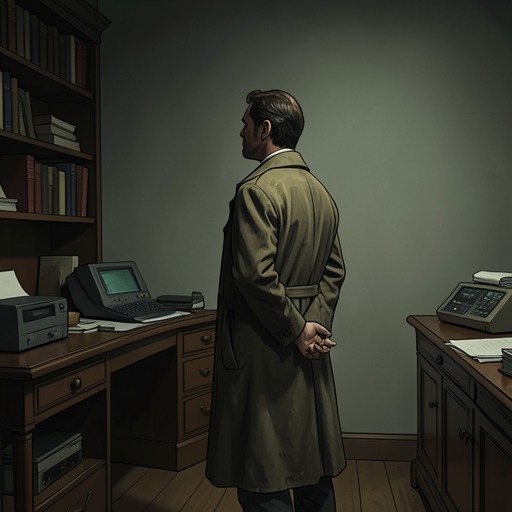
The hole on the bookshelf
Three SecondsThe hole on the bookshelf is both a physical detail in Ewert Grens’s office and the image around which his final uncertainty gathers. As he studies prison footage and weighs what it means, the hole seems to grow; its unfilled space gives form to a question he cannot settle by watching alone: whether the man who vanished through the prison gate is dead or alive.
The image in Grens’s office
Grens sits before a bookshelf with a hole that cannot be filled, while dust lies in straight lines no matter how often he wipes it away. He has been at his desk for nearly three hours, trying to decide whether what he has just seen deserves concern or will lose its significance if it cannot be shared with someone else. The hole belongs to this suspended interval: it is not explained or repaired, but remains visible while he struggles to reach a conclusion.
The narration makes the image dynamic. “It was as if it was growing,” and Grens’s attention stays fixed on it until he has made up his mind. The physical gap does not supply an answer; instead, its apparent growth gives material shape to a decision delayed. The repeated image turns a familiar object in the room into a measure of how urgently the unresolved question occupies him.
The footage and the inference
For two days, Grens has fast-forwarded and rewound recordings from Aspsås prison, studying locked doors, passages, walls and barriers frame by frame. He has also examined Nils Krantz’s forensic reports, the autopsy report, and interviews conducted by Sven Sundkvist and Mariana Hermansson. Among the details he concentrates on is a uniformed person speaking with a guard before looking up at a camera—the same deliberate look Grens recalls from footage of another security office.
Grens follows the person on cameras fifteen and sixteen, through a metal detector and the prison gate and wall. The person has trouble keeping his balance after an enormous blast. In the silence of the office, Grens’s recognition breaks through as the words “You're alive.” The passage does not name the person in this moment; it makes the conclusion emerge from Grens’s close review of the recording and the figure’s passage out of the prison.
Absence, doubt, and the ending
The bookshelf image gathers force because Grens cannot treat the footage as just another piece of evidence. He has watched the seconds of the prison crisis that erupted into smoke and deaths, yet the recording also shows someone leaving. His question is not simply what the camera captured, but whether he is prepared to accept what that image means. The growing hole marks the distance between seeing a figure escape and making a decision about death.
The thought “I didn't make a decision about death” brings that distinction to the surface. Grens has not decided that the man is dead; after watching the footage again, he recognizes that he is alive. The bookshelf remains unfilled, but the scene’s uncertainty changes direction: what had seemed like an absence without an answer becomes evidence that the story has not ended where the prison explosion appeared to end.